She stood on the corner every morning—frail, hunched, wrapped in a faded green sweater. Her name was Ana, though most people didn’t know it. They simply called her “the grandmother with the vegetables.” She sold tiny bags of parsley, onions, carrots she grew in her garden, earning a few coins at a time. Not enough to live on, but enough to make her feel she still had a purpose.
On that particular morning, two patrol officers walked by—their shift was quiet, and they had seen her before. They knew she wasn’t dangerous. They knew she wasn’t running some big illegal operation. She was just an old woman trying to survive. One officer even whispered, “We should just let her be… she reminds me of my own grandma.”
But by law, street selling without a permit was an offense. They approached gently, ready to give Ana a simple warning.
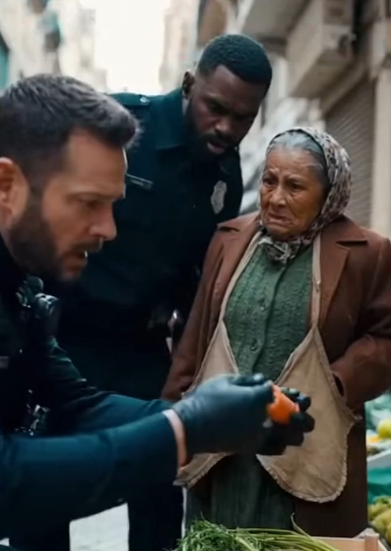
When they reached her table—a small wooden crate resting on a stool—they found the usual items: carrots bundled with twine, a few tomatoes, a handful of onions, and a cloth bag tied tightly at the top. Ana’s hands trembled as she lifted it.
Then one of the officers leaned down to inspect the vegetables. He wasn’t searching for trouble—he was honestly curious. But when he picked up one of the carrots, his eyes widened. It felt strangely heavy.
He examined another. Same thing.
He finally looked at Ana.
“Ma’am… what’s inside these?”
Her lips quivered. “I… I didn’t want to…”
The officer gently broke open the carrot—and the truth spilled out like a secret crashing into daylight.
Inside the hollowed vegetables were tiny packets wrapped in plastic. Dozens of them. Hidden so skillfully that you’d never guess unless you broke one open.
The second officer stepped forward, stunned. “Where did you get these?”
Ana shook her head violently, tears streaming down her face. “They told me if I don’t sell them, they will hurt my grandson. They came to my home at night. I didn’t know what else to do…”
She wasn’t a criminal.
She wasn’t a mastermind.
She was a terrified grandmother being used by people who prey on the vulnerable.
But the law required action. The officers had to follow procedure. They gently placed her hands together—no force, no harsh voices—and walked her to the patrol car. As they did, Ana kept whispering through broken breaths:
“I only wanted to protect him… my grandson… he is all I have left…”
What the public didn’t see, however, was what happened next.
At the station, the officers contacted child protective services—not to take the boy away, but to keep him safe. They called detectives to investigate the criminals who threatened her. They filed a report emphasizing she had been coerced. They even arranged for her grandson to receive emergency care and protection until the perpetrators were found.
And when Ana, trembling in a chair, asked, “Will they hurt him?”
The younger officer knelt down beside her and said softly:
“No, ma’am… not anymore. You’re not alone now.”
Her arrest was only the beginning—
the beginning of uncovering a deeply hidden network, the beginning of justice,
and the beginning of giving a frightened old woman her life back.
Sometimes the harshest scenes hide the most heartbreaking truths.