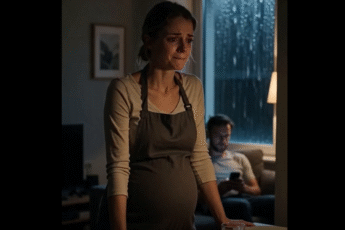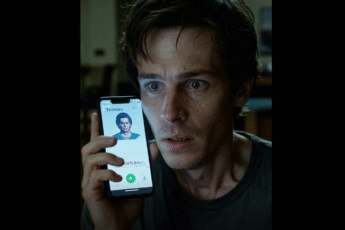
Every evening, people hurried through Alexanderplatz in Berlin without noticing the small boy sitting near the subway entrance.
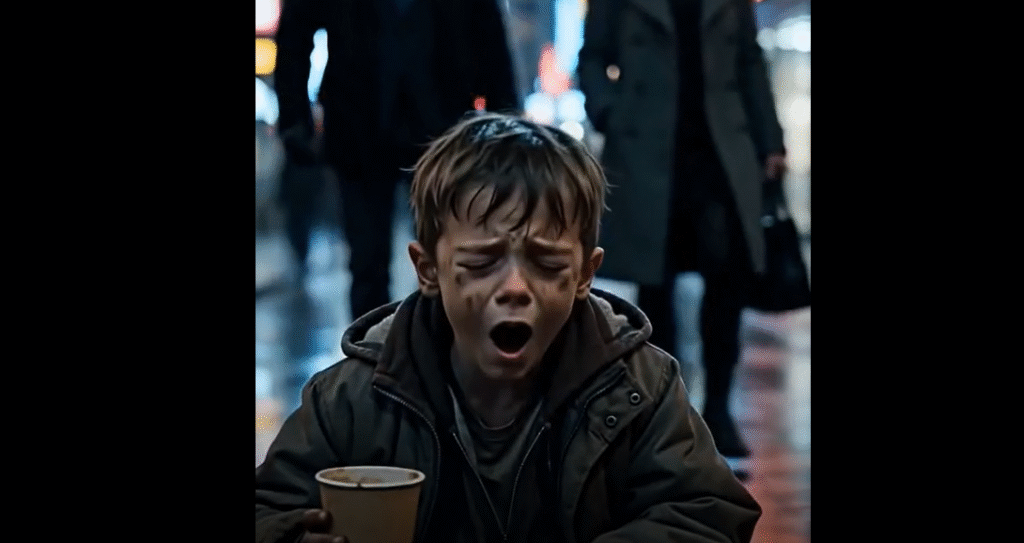
He looked no older than ten.
His oversized gray hoodie hung loosely over his thin shoulders, and his sneakers were torn from the rain and cold. In front of him stood a paper cup with only two small coins inside.
Most people ignored him.
Some looked away out of guilt.
Others judged him openly.
“Du bist alt genug zum Arbeiten, nicht zum Betteln,” a woman muttered one night before walking away with her shopping bags.
The boy lowered his eyes and quietly whispered, “Ja, Frau…”
His name was Elias.
And he hated begging.
Every morning before sunrise, Elias left the abandoned building where he lived with his little sister, Mia. Their parents had died in a car accident two years earlier, and since then they had been moved between shelters, relatives, and temporary homes until eventually nobody wanted the responsibility anymore.
So Elias learned to survive alone.
He stole bread sometimes. Collected bottles. Slept lightly. Lied to social workers because he was terrified they would separate him from Mia.
Mia was only five.
She believed her brother could fix everything.
And Elias tried.
Every night he told her stories before bed — stories about castles, oceans, and magical cities where nobody was hungry. Mia always smiled before falling asleep.
But the truth was crueler than the stories.
That winter was especially brutal.
One evening, snow mixed with rain as Elias sat outside the station shivering violently. He had earned almost nothing the entire day.
His stomach hurt from hunger, but he kept thinking about Mia waiting in the abandoned building wrapped in an old blanket.
Then a businessman in a dark coat stopped in front of him.
The man looked irritated as he dropped a coin into the cup.
“Solche Kinder sieht man überall,” he sighed.
Elias tried to thank him, but suddenly a violent cough shook his body. His vision blurred. He nearly collapsed onto the sidewalk.
People finally stopped walking.
Some stared.
Some filmed with their phones.
Elias lifted his pale face and whispered weakly:
“Meine kleine Schwester hat seit gestern nichts gegessen…”
Silence spread through the crowd.
The businessman froze.
Something about the boy’s eyes felt familiar.
Very familiar.
Then Elias pulled a small photo from his pocket — a worn picture of him and Mia smiling beside a woman with curly blonde hair.
The businessman’s face lost all color.
The woman in the photo was his younger sister, Hannah.
Years ago, after a painful family argument, Hannah had cut contact with everyone. When she died in the accident, the family never managed to locate the children through the broken legal system.
And now… her son had been begging on the streets right in front of him.
The businessman staggered backward in shock.
His name was Markus.
And he was Elias’s uncle.
That night, Markus drove through the freezing rain searching for the abandoned building Elias described.
When he opened the rusted door upstairs, he found little Mia asleep on the floor holding a stuffed rabbit with missing eyes.
Markus broke down crying.
He knelt beside her carefully.
For years he had spent his life chasing promotions, money, status — while the only family he had left survived in darkness and hunger only a few streets away.
The next morning, Mia woke up in a warm hospital bed beside Elias.
For the first time in months, both children had eaten a real breakfast.
They were frightened at first. Distrustful.
But Markus kept showing up.
Every day.
He brought Mia toys. Helped Elias enroll in school. Sat through therapy sessions. Learned how to braid Mia’s hair terribly badly just to make her laugh.
Slowly, the children stopped looking at him like a stranger.
Months later, on Elias’s eleventh birthday, Markus gave him a small wrapped box.
Inside was a key.
“To what?” Elias asked carefully.
Markus smiled with watery eyes.
“To home.”
Outside the window stood a small yellow house near the edge of the city.
Nothing luxurious.
But warm.
Safe.
Real.
Mia ran through the hallway laughing while Elias stood frozen in disbelief.
Then Markus handed him another thing — the old photograph Elias used to carry in his pocket.
“I think your mother would be proud of you,” he said quietly. “You protected your sister when no one else did.”
Elias looked down at the photo for a long moment.
Then, for the first time since losing his parents, he finally allowed himself to cry.
Not from fear.
Not from hunger.
But because after years of surviving…
He was finally home.